When Companies Turn Off Your Smart Devices
· 6 min read · Rohan Kumar
Companies can remotely shut down devices you paid for. From Revolv and Spotify Car Thing to Humane AI Pin and Belkin Wemo, this video explores planned obsolescence, cloud-dependent products, software ownership, and why smart devices can become useless while the hardware still works. We also look at Matter, Home Assistant, and Right to Repair.
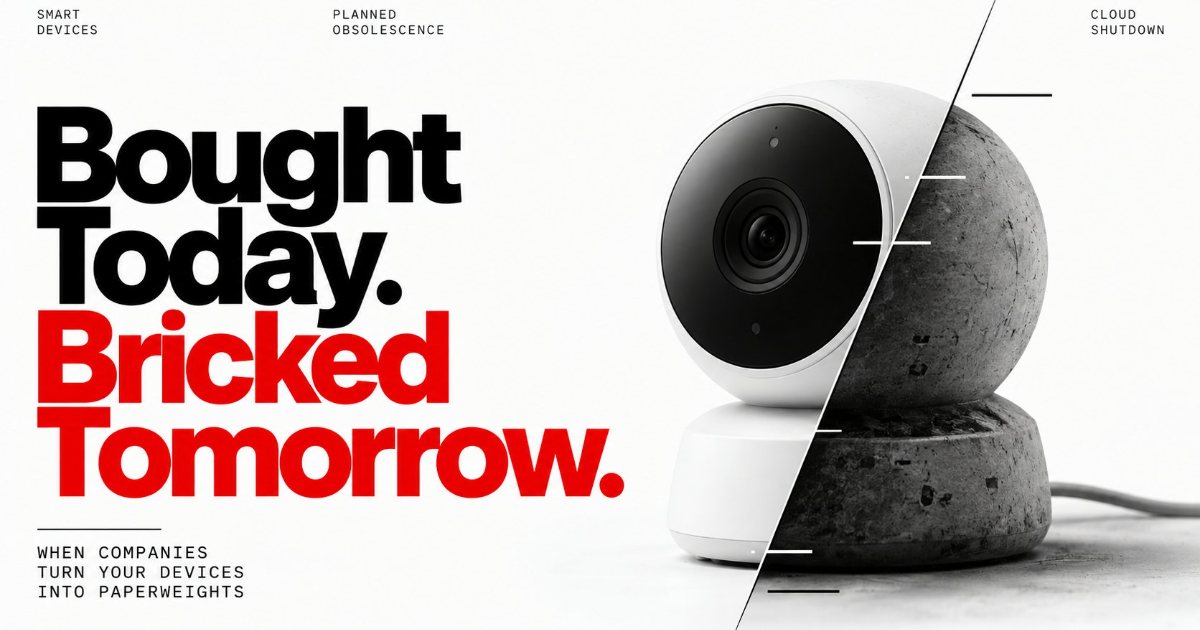
In 2016, people who owned a smart home hub called Revolv got an email from the company. From May 15, the app wouldn't open and the hub wouldn't work. Nothing was wrong with the hubs. The company had just decided to turn its servers off.
It turns out this keeps happening, and most of the time it's completely legal. I'll go through a few cases, and by the end I think you'll agree with me on one thing: if a company sells you a product, it shouldn't get to turn it into a paperweight whenever it likes.
Revolv cost 299 dollars and came with what the company called a lifetime subscription. Nest, which is part of Alphabet, Google's parent company, bought it in 2014, stopped selling it straight away, kept it running for a while, and shut it down about two years later.
So "lifetime" meant "until we get bored". Nest did end up giving full refunds, fair enough, but the hub was never broken. It just had nothing to talk to anymore.
Spotify's Car Thing, a 90 dollar music player for your car, stopped working in December 2024. Spotify did refund owners, but only after people got angry online, around the same time a class action lawsuit was filed, and only if you could show proof of purchase. What it told everyone first, on its support page, was to reset the device and dispose of it as e-waste. Reset it, then bin it. Thanks for the music.
Then there's the Humane AI Pin, which I think is the worst one. It launched at 699 dollars, plus a monthly subscription. In February 2025, Humane sold its software, patents and staff to HP for 116 million dollars, and the Pin was cut off from its servers. Only people who'd bought it in the previous 90 days got their money back. So if you bought one at launch, you'd paid 699 dollars for a very expensive lapel decoration.
Compare that with Revolv, where everyone got a full refund. Car Thing owners got one if they complained and still had the receipt. Most AI Pin owners got nothing. Same kind of shutdown, three different outcomes, and the only one who decided which one you got was the company.
The newest one is from this year. On January 31, Belkin turned off the cloud for most of its Wemo products. That's more than two dozen of them, so the plugs and light switches, but also space heaters, coffee makers and baby monitors. Wemo had been around since 2012, so people had built a lot of their home around it. Yes, a baby monitor that needs a company's server to work. Belkin said it might give partial refunds, but only for devices still under warranty, and most of the affected ones were long past that.
Not every Wemo device died, though. A few models that work with Apple HomeKit carried on, but only if you'd set them up through HomeKit before the shutdown. And four newer models that use a standard called Matter weren't affected at all. Remember that word, I'll need it later.
Most of us here in India didn't buy these exact devices. But if you have an older smart TV where YouTube or Netflix has gone missing or throws an error, even though the screen is perfectly fine, that's the same thing, just smaller.
What I kept asking while reading all this was why these things need a company's server in the first place. It's in your house. It's on your own Wi-Fi. Why can't it just do its job?
Money is the obvious one. You pay once, when you buy the device, but the servers cost money every month, for every old device that's still online. After a few years those devices aren't bringing in anything new and the bill keeps coming.
Subscriptions are the other big one. A monthly fee is steady income, which is why cameras, doorbells and pretty much everything else now comes with a plan. For some of these companies, the device is basically a very expensive sign-up form.
But the one that actually makes all this legal is the terms and conditions that nobody reads, me included. In a lot of them, the software inside your device isn't sold to you. It's licensed to you.
So what you actually own is the plastic, the glass and the circuit board. The smart part is on loan, and the company decides when to take it back. You bought a lamp, and the light is on a rental. At full price. That's the part I have a problem with.
Back to my question about working offline. After the shutdown, the AI Pin could still show its battery level. Calls, messages, all the AI features ran through Humane's servers, so they went with it. A 699 dollar gadget that could tell you its battery percentage, and nothing else.
Now think about what a device that works fully offline means for the company. They get no data from you, they can't sell you a subscription for it, and you've got less reason to buy the new model. I don't think every company plans it that way, but it's not exactly a problem they're rushing to fix either.
This matters more every year because software is in everything now. Cars, washing machines, ACs, TVs, electric scooters. A lot of them want an app and an account before they'll do their one job.
A few years ago BMW tried charging a monthly fee for heated seats in some countries. The heating hardware was already in the car. People hated it and BMW dropped the idea, so complaining does work, apparently.
There are some good things happening too.
Those four Wemo devices that survived use Matter, a smart home standard that works with Google, Apple, Amazon and Samsung. Many Matter devices can be controlled locally, inside your home, with no company cloud in the middle. And there's a free piece of software called Home Assistant that lets you run your smart home on your own hardware.
Governments are paying attention too. India launched a Right to Repair portal in 2022, and the European Union has passed its own repair rules.
Even phones have improved. My Pixel is supposed to get seven years of updates, and not that long ago Pixels got three.
But repair rules are about fixing hardware. None of them stop a company from switching off the software.
Now, I get it. Nobody can run servers forever. That's actually why I think there should be a rule: if a company is going to switch off something it sold you, it should either refund you or let the device keep working without the cloud. And that's not far-fetched. Matter devices already work locally, and Home Assistant already lets people run it all themselves. If a company can't promise one of those two things, maybe it shouldn't be selling you a gadget that depends on it.
Until that changes, check before you buy. Ask what happens if the company shuts down. Can it still work locally? Does it support Matter? If it only works through the company's app and cloud, it can stop working long before the hardware wears out, and you'll have no say in it.
Has this happened to you? A device that died, or a TV app that disappeared one day? Tell me in the comments. And if you want to see what Google is doing with its own ecosystem, my Googlebook video is next.